Ask most agencies how they drive local search visibility and you will get the same checklist: optimize your Google Business Profile, build citations, earn a few backlinks, wait two to four months. It is all technically true, and it is also what everyone says. It does not tell you what real visibility looks like, how it is measured, or which levers actually move the needle first.
We run our own local SEO in the Kansas City metro, so we can show you with our own numbers. Here is what real search visibility looks like when you measure it honestly, and the specific levers that moved our profiles, in the order that returns the most.
Real visibility is a map, not a single ranking
The first thing to understand is that local rankings are not one number. Where you rank changes with the physical location of the person searching. You can sit at position one at your own front door and be invisible three miles away, because Google weighs how close the searcher is to your business. A single rank check hides that completely.
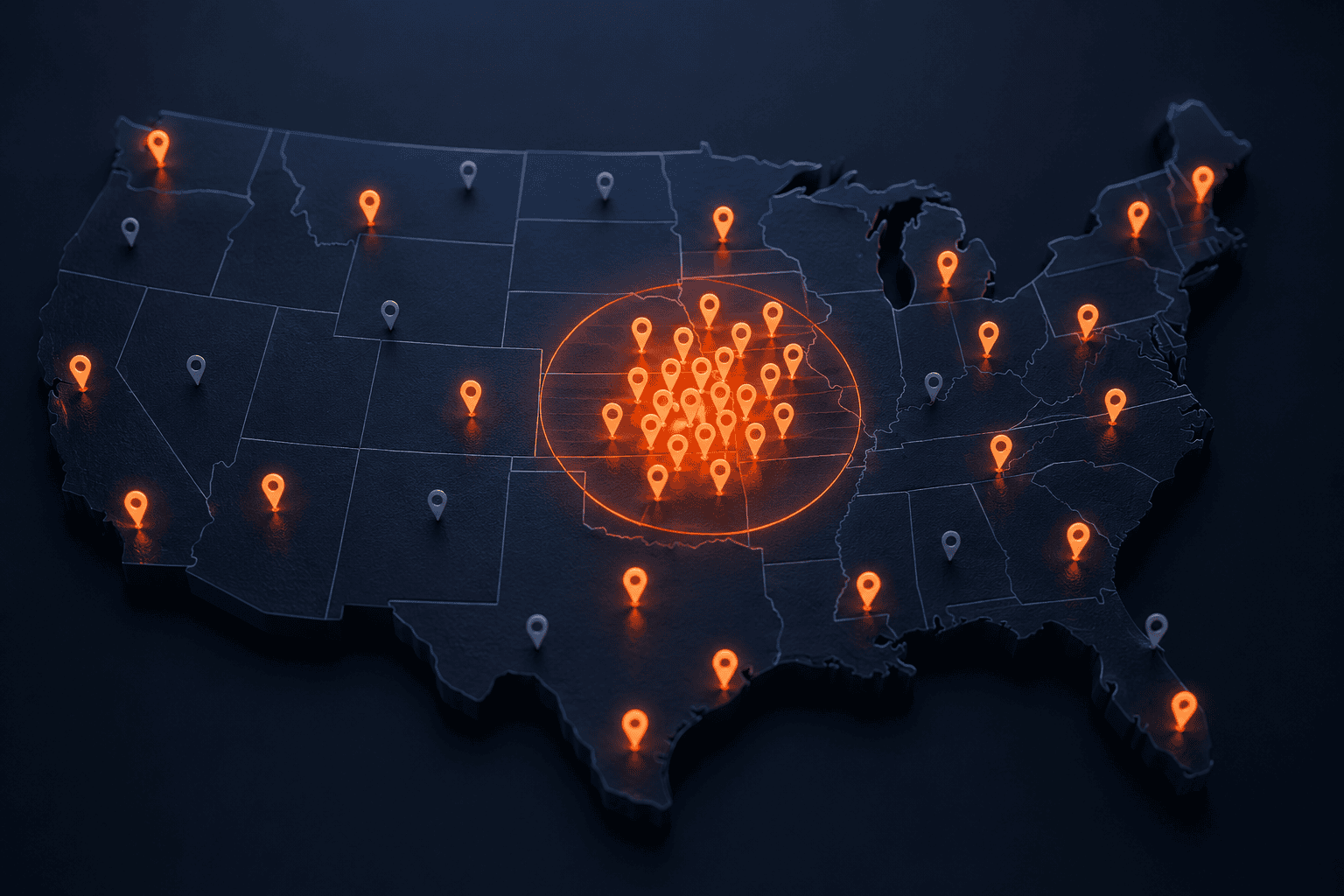
So we do not measure a single rank. We drop a grid of points across the market and check where your business appears in the local results at each point. Then we track Share of Local Voice, which is the percentage of that grid where you show up in the top results for a given term. A business owner asks “am I number one?” We ask “across how much of the map do people actually see you?” That is the honest question, because it matches how customers really experience local search.
The dropdown that can outrank your website
Here is the part almost no one tells small business owners. The single strongest relevance signal for the local map pack is not your website copy and it is not your backlink count. It is your Google Business Profile primary category. Two businesses at the same address, with the same website, can have opposite visibility based on that one setting.
We proved it on ourselves. We manage two profiles in the Kansas City metro. One of them had a primary category that did not match the services we wanted to be found for. On the geo-grid it scored zero percent Share of Local Voice for the terms that matter. Not low. Zero. Invisible across every single point on the map. The website was not the problem, because it already had the pages. The problem was one dropdown. We changed the primary category to match the actual service focus, and we are now measuring the lift across the same grid.
The lesson we take into every account is simple: category relevance is the foundation. Content and links compound on top of it, but they cannot rescue a category that tells Google the wrong thing about your business.
What “owning” a term actually looks like
When the fundamentals line up, the map fills in. Our Kansas City profile, measured on that same grid, holds roughly a 51 percent average Share of Local Voice and dominates its core term. It appears in the top local results across about 82 percent of the grid for “local SEO” and above 90 percent for the state-qualified version of that search. That is what real visibility looks like: not a screenshot of a number one ranking, but presence across most of the map for the terms that bring in customers.
That coverage did not come from a single trick. It came from the right primary category, a complete and consistent profile, service pages that genuinely earn the terms, and reviews, all pointing the same direction. And because we measure on a grid, we can see exactly which parts of the metro are working and which squares still need attention.
The gap between having a page and being found
A common and expensive assumption is that building a service page means you will rank for that service. You will not, if your Google Business Profile does not also tell Google you offer it. We watched this happen on our own profile: a term we had a dedicated, indexable page for still scored zero percent across the grid. The page existed. The relevance signal did not, because that service was never listed on the profile.
Your website and your Google Business Profile have to say the same thing. When they disagree, the profile usually wins in the local pack. So we closed the gap by adding the service to the profile, and part of our Google Business Profile optimization work on every account is making sure the services listed on the profile mirror the service pages on the site.
What we actually do, in order
Most agency checklists are alphabetical. Ours is ordered by measured impact, because the sequence changes the result. Fixing categories before writing content returns far more than doing it the other way around.
- Get the categories right. Set the primary category to the single term you most want to own, then add the relevant services that mirror your pages. This is the highest-leverage move, and it is why we wrote a separate guide on how your primary category works.
- Complete and align the profile with the site. Name, address, and phone, services, hours, photos, and reviews all need to agree with what the website says.
- Build the pages that earn the terms. Service and city pages that answer real local intent, then link them cleanly so authority flows to the pages that convert.
- Earn local citations and links. Consistent listings and trusted local mentions reinforce the signals already in place.
- Measure on a grid every month and move resources to the weak squares, rather than guessing.
Why we measure everything on a grid
A single rank check will tell you what you want to hear. You can rank number one where you are standing and lose the customer a mile down the road. The grid shows the truth, and it tells us where to work next. It is also how we report progress to you, not with a vanity ranking that moves with the weather, but with how much of your actual market can see you this month compared to last.
That is the difference between an agency that hands you a ranking screenshot and one that drives real visibility. Real visibility is measurable, it is tied to a map of your market, and it starts with getting the signals right in the order that matters.
What separates a real agency from a checkbox vendor
A checkbox vendor sells you activity. You get a monthly report of tasks completed: posts published, citations submitted, a directory count that went up. None of it answers the only question that matters, which is whether more of your market can find you than could last month. Activity is not visibility.
A real agency sells you measured outcomes. We tie every task to a specific weak area on your grid, then show you the map moving. If a block of your market is dark for a term that brings in customers, we trace why, whether it is a category, a missing service, a thin page, or a proximity gap we cannot change, and we fix what can be fixed. If a tactic does not move the grid, we stop doing it. That discipline is the entire difference. The checkbox vendor is busy. A real agency is accountable to the map.
Frequently Asked Questions About Local Search Visibility
What does real local search visibility actually mean?
It means showing up across the map of your market, not ranking number one at a single point. We measure it as Share of Local Voice, the percentage of a grid of locations across your area where your business appears in the top local results for a search term.
What is the single biggest local ranking lever?
For the local map pack, it is your Google Business Profile primary category, along with the services listed on the profile. In our own testing, a mismatched primary category left a profile at zero percent visibility even though the website was fine.
Why isn’t my business showing up even though I have a website?
Usually because your profile and your site do not say the same thing. If a service is on your website but not listed on your Google Business Profile, or your primary category is wrong, Google may not connect your business to that search. The profile has to mirror the site.
How do you measure local SEO progress?
We run a geo-grid scan across your market every month and track Share of Local Voice for your priority terms. That shows exactly where you gained or lost coverage, rather than relying on a single rank check that changes with the searcher’s location.
How long before local SEO shows results?
Profile and category fixes can move the local pack within a few weeks because they change relevance signals directly. Content, links, and authority compound more gradually over several months. We measure both on the grid so you can see progress as it happens.